
November 26, 2026
The Searchlight Investigation With Supplementary Evidence and Analysis
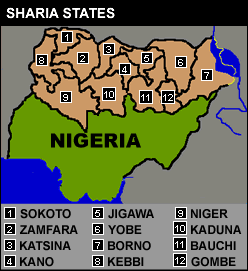
The “two-track justice system” in Nigeria described by The Searchlight in the previous report, operates nationwide but in the twelve northern states that implement Sharia criminal law, this dual system wears a sacred cloak, making it more hidden and harder to challenge. Sharia is proclaimed as “the law of God,” which should transcend earthly inequality. Yet available evidence shows that in actual enforcement in northern Nigeria, Sharia’s punitive provisions fall almost exclusively on the poor, low-level traders, commercial drivers, and impoverished women; while politicians who embezzle billions in public funds and the powerful who protect thugs are never touched by the same body of law. When “sacred justice” is used for class governance, it ceases to be justice and becomes religious cosmetics for power.
The Arrested Hungry: Class Filtering in Ramadan Enforcement

Every year during Ramadan, arrest operations by the Kano State Hisbah (Islamic morality police) have become a seasonal ritual. In February 2026, Hisbah arrested nine people in Kano for not fasting, seven men and two women. Hisbah Deputy Commander Mujahid Aminudeen told the BBC that these individuals “pretended not to know Ramadan had begun” and were detained to “learn the importance of fasting, how to pray, recite the Quran, and become better Muslims”.
Who was arrested? Columnist Lasisi Olagunju gave a blunt answer: “Those arrested were the poor, the nameless, the expendable”, adding that “The morality police are everywhere. They patrol markets, search cafes, inspect bodies to confirm piety. Yet in the gilded palaces of those who commissioned Hisbah to enforce morality, sin reigns undisturbed”.
Critics have long pointed out that such enforcement “disproportionately targets the poor, especially street vendors, commercial motorcyclists, and manual labourers, while wealthier residents rarely face the same scrutiny”. A labourer buying food at a roadside stall is arrested; a politician squandering public funds in a mansion is never questioned by Hisbah. This is not an enforcement oversight; it is an enforcement choice.
Hisbah’s Self-Admission: We “Leave the Rich to God” and Act Against the Poor
In a 2021 radio interview, a director of the Kano State Hisbah Board offered an official explanation for this selective enforcement, its candour was staggering. At that time, Nigerians were demanding that Hisbah arrest and punish Zarah Ado Bayero, the bride at the wedding of President Buhari’s son Yusuf, over attire deemed “inconsistent with Islamic norms.” Meanwhile, Kannywood actress Sadiya Haruna had just been sentenced by a Sharia court to six months in an Islamic school for “posting sexual content on social media.”
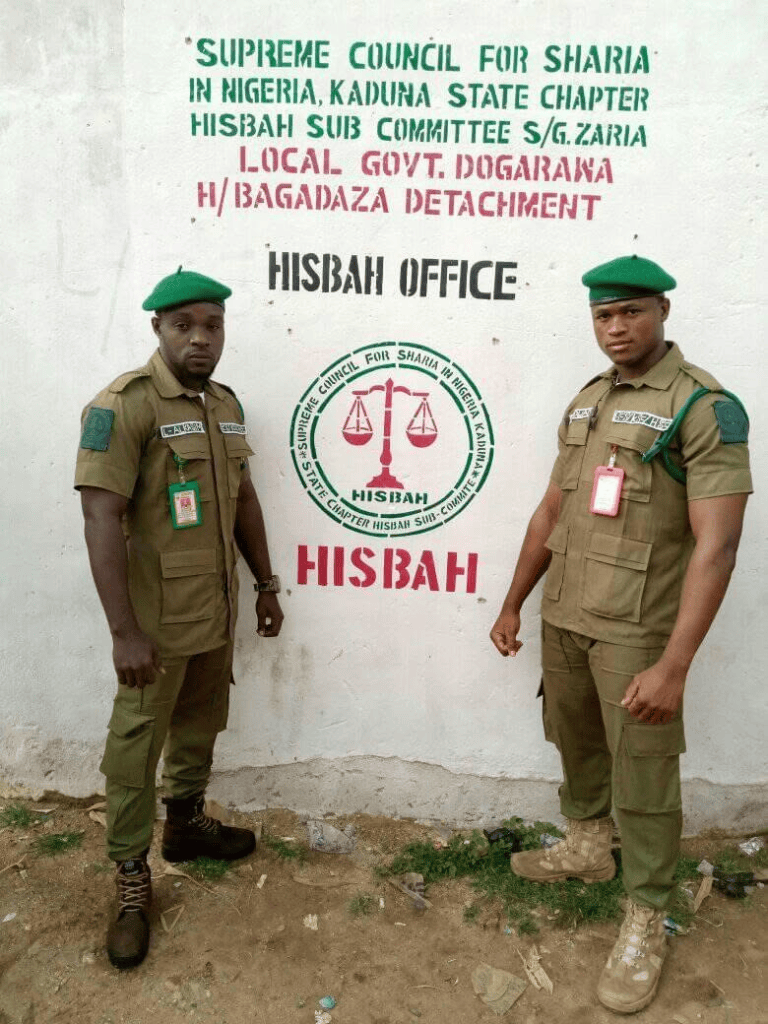
Hisbah Board Director Aliyu Musa Aliyu Kibiya responded that the Board handles matters involving the rich “very carefully” and that such matters would be “left to God for judgment.” He said: “We see things differently. If a leader errs, publicly proclaiming it in the mosque is against Islamic teachings. We have ways to reach leaders and preach to them… but the way you summon an ordinary person and the way you summon a leader are different.”
This statement must be understood word for word. It is not denying the double standard; it is rather providing theological justification for the double standard. Violations by the rich and powerful are “left to God”, a jurisdictional transfer that is unverifiable and unenforceable. Violations by the poor are met with immediate arrest, detention, and discipline by Hisbah. When asked to provide a list of wealthy individuals who had been punished, Hisbah “had not yet published one.”
The Intersection of Gender and Class: Poor Women Bear the Full Weight of Adultery Punishment
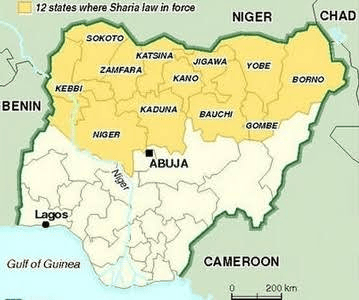
Since the implementation of Sharia criminal law in the north, the most internationally scrutinized cases have revealed a recurring pattern: women are convicted because of pregnancy, while men are released for lack of evidence.
Human Rights Watch’s documentation explicitly states that in cases such as Amina Lawal, Safiya Hussaini, and Bariya Magazu, “women were convicted and sentenced to death or flogging on the basis of their pregnancy, while the named men were acquitted for lack of evidence”.
The Bariya Magazu case is particularly telling. This teenage girl was accused of extramarital sex, but she simultaneously alleged that three men had raped her. Instead of investigating her rape allegation, the judge charged her with “false accusation” and the three men were released after denying any sexual contact. Under Sharia criminal law, rape by a married perpetrator can carry the death penalty, and by an unmarried perpetrator can carry flogging. Yet the rape allegation was never seriously addressed; the victim became the defendant.
Academic research summary of such judgments shows that these decisions “reflect the poor training of rural lower-level judges and the class and gender bias of the system”. When a poor, unmarried, pregnant woman, often illiterate, stands in court facing one or more socially connected men, the scales of justice have already tipped before the hearing begins.
The “Political Nature” of Sharia: Why the Powerful Are Immune
In northern Nigeria, Sharia criminal law has been implemented for over two decades. During this period, no state governor, senator, or billionaire has been brought before a Sharia court on corruption charges. This is not because there is no corruption in the north; it is because Sharia, as practiced, has been calibrated to focus on the “moral conduct” of the poor rather than the “financial crimes” of the powerful.
A human rights activist’s summary in 2002 remains accurate today. It said “Sharia does not touch the rich, politicians, aristocrats, and feudal lords. There are people in this country who have looted billions of naira and never been prosecuted, and then you see someone prosecuted and punished under Sharia for stealing a bicycle or a cow.”
This selective immunity is not accidental. It is a political choice. Northern political elites need Sharia to consolidate local legitimacy, but they do not need Sharia to constrain their own behaviour. Therefore, Sharia’s punitive machinery is directed downward, at street vendors, young people, women, while pointing upward, it transforms into moral exhortation and “leaving it to God.”
Consequences: When Religion Becomes a Tool of Oppression
The harm this pattern inflicts on Nigerian society is multifaceted.
Harm to Sharia itself. When Sharia is equated in public perception with “flogging impoverished youth” and “letting corrupt governors go,” the moral authority of religion is politically consumed. Large numbers of northern Muslims appear disillusioned with Sharia practice, not because they oppose Islamic law, but because they see it being used as a tool of selective punishment.
Harm to the rule of law. Nigeria’s constitution explicitly provides for separation of religion and state and freedom of religion, but Hisbah in northern states systematically violates these provisions in practice, and the federal government has never taken effective action to stop it. This sends a signal to all citizens that constitutional rights can be suspended in specific regions and under specific conditions. In a place where the constitution can be arbitrarily suspended, the rule of law does not exist.
Direct harm to the poor. A hungry 26-year-old man tried to sell himself to survive and received not assistance but detention. A 19-year-old received not freedom of expression but five months in prison and ten strokes of the cane for criticizing a government agency on social media. When a society’s legal system imposes the harshest punishments on its most desperate people, it is no longer a system of “justice”; it is a system of “order maintenance.” Whose interests are being maintained is clear at a glance.
What The Searchlight’s Demands
First, the Kano State Government must immediately abolish Hisbah’s quasi-judicial powers. Any punishment involving personal liberty, detention, flogging, imprisonment, may only be imposed by regular courts through due process. Hisbah’s existence as a moral persuasion body is open to discussion and its existence as an enforcement and punishment body violates the constitution.
Second, the Federal Attorney-General should initiate constitutional review of provisions in northern states’ Sharia criminal laws that conflict with Nigeria’s constitution. Particularly those involving flogging, insulting religious institutions, and imprisonment without the option of a fine. This is necessary if we believe that constitutional supremacy is not optional.
Third, the international community, particularly the UN Human Rights Council and the European Union, should incorporate Hisbah’s systematic rights violations into human rights reviews of Nigeria, rather than avoiding them on grounds of “religious sensitivity.” Flogging the poor is not culture; it is torture.
Fourth, every politician who claims to represent the interests of northern Muslims should be asked one simple question: When was the last time you supported applying Sharia criminal law to a governor or senator accused of corruption? If the answer is “never,” then your defense of Sharia has nothing to do with justice.
Conclusion: Sharia in northern Nigeria has been practiced for a quarter of a century. After a quarter of a century, what people see is that the cane falls on the backs of the hungry, the fine slip is handed to the embezzler, and the courtroom doors are wide open to the poor and tightly shut to the powerful. When religion is used as rhetorical cover for class oppression, the victims are not only the poor but religion itself.


Leave a Reply