
By Matthews Otalike, The Searchlight Correspondent / November 01, 2026
The Searchlight has been raising concerns on the implications of the unending loans being taken by the Tinubu administrations since 2023 and their implications for Nigeria’s development. Interestingly, the National Assembly appears complicit in the approval of the loans without explanation on the projects or programmes for which they would be spent.
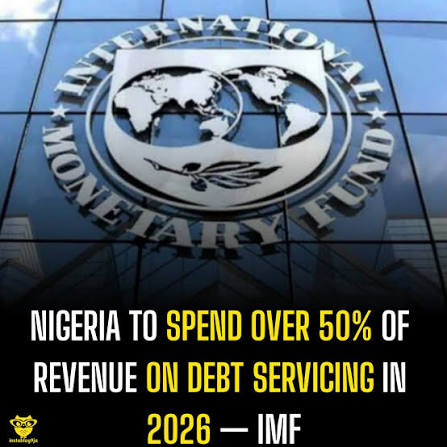
In June this year , the International Monetary Fund’s Resident Representative in Nigeria, Christian Ebeke, delivered a series of pronouncements that should have jolted every Nigerian awake. Speaking on ARISE News and in a high-level briefing with business executives in Lagos, Ebeke laid bare the grim arithmetic of Nigeria’s debt under President Bola Tinubu. He said the country may not be “debt-distressed” on paper, but it is devoting roughly half of its tax revenue to servicing interest payments, while a flagship $5 billion loan from a UAE bank is so opaque that even the IMF cannot decipher its terms. The Searchlight argues that this is not a sustainability story; it is a warning that Nigeria is quietly mortgaging the future of generations yet unborn.
The Disclosure That Should Haunt Nigerians
Ebeke’s most explosive revelation came during an engagement with business executives in Lagos. He disclosed that approximately 2 per cent of Nigeria’s GDP, which is about ₦8.8 trillion, in public spending was executed outside the official budget framework in recent years. This is not a minor accounting discrepancy. It means the fiscal deficit reported to Nigerians and international partners is artificially smaller than the government’s true borrowing requirement. Capital projects were executed off-budget, financed through channels that bypass appropriation and scrutiny. As Ebeke put it, the omission “makes Nigeria’s fiscal deficit appear smaller than the government’s actual borrowing requirement”.
In plain terms: the Tinubu administration has been borrowing and spending in the shadows. The debt Nigerians are told about is only part of the story. The rest is buried in unrecorded expenditure, a “shadow budget” that future governments will still have to repay, even though no Nigerian voter approved it.
Half of Every Tax Naira Goes to Interest
Ebeke was blunt about the consequence. In his June assessment following the IMF’s Article IV consultation, he confirmed that Nigeria’s debt-to-GDP ratio remains in the mid-30 per cent range, and that the risk of sovereign stress is “moderate”. But he immediately qualified that comfort stating that between 2025 and 2028, the interest-to-revenue ratio is expected to hover around 50 per cent, and the IMF projects interest payments will consume 53.7 per cent of federal revenue in 2026, up from 40.8 per cent in 2024.
“When you have more than 50 per cent of your tax collection devoted to repaying interest on your federal government debt, it leaves you very little room to actually pay for health, education, cash transfers and security,” Ebeke warned.
This is the crux of the matter. A low debt-to-GDP ratio is meaningless when the state can barely fund its recurrent obligations, let alone capital expenditure. Every naira that goes to bondholders and multilateral lenders is a naira stolen from a child’s classroom, a primary health centre, or a police station.
The $5 Billion UAE Loan: Opaque, Over-Collateralised, and Risky
If the interest burden were not alarming enough, Ebeke also took direct aim at the Tinubu administration’s plan to raise $5 billion through a derivatives-based total return swap with First Abu Dhabi Bank. The IMF’s warning was unambiguous. Ebeke described such transactions as “often opaque and complex,” with terms that are “not always very transparent” when reviewed across countries. He revealed that Nigeria had pledged collateral valued at 133 per cent of the transaction amount, a staggering over-collateralization that raises serious questions about the deal’s cost-effectiveness.
However, the government proceeded with the deal anyway, with the National Assembly approving it in March. But Ebeke’s caution deserves repeating: Nigeria retains access to international capital markets and could issue Eurobonds in a “more transparent and less opaque way”. Instead, the administration chose a structure that even the IMF cannot fully scrutinize. When a sovereign borrows billions through instruments it does not fully disclose, the risk is ultimately borne by taxpayers, and by their children.
The Debt Stock Is Ballooning: And the “Future Generation” Defence Is Inverted
According to the Debt Management Office, the Tinubu administration has added ₦72 trillion in fresh debt, bringing total indebtedness to ₦159.35 trillion as of early 2026. The public debt stock stood at $110.3 billion (about ₦159.2 trillion) as of December 31, 2025. President Tinubu has repeatedly defended this accumulation by arguing that borrowing is for infrastructure and for “future generations.” But the evidence presented by Ebeke inverts that logic.
When half of tax revenue is consumed by interest, the state is not investing in future generations; it is pre-paying for the consumption of the present. The roads, ports and power projects that loans are supposed to finance are necessary, but they are being financed through mechanisms that are opaque and expensive. The off-budget spending Ebeke flagged means some of the borrowed funds are not even subject to public scrutiny. Future Nigerians will inherit the debt, the interest burden, and the collateral obligations, but they may not inherit the assets, because no one can say for sure where the money went.
Former President Olusegun Obasanjo captured the moral dimension of this crisis when he warned that “debt destroys generations” and that excessive borrowing endangers “the future of entire generations”. Ebeke, a technocrat who is not given to hyperbole, stopped short of such language. But his numbers speak for themselves: a state that spends half its revenue on interest has already sacrificed the fiscal space needed to educate, heal and protect its people.
What Nigerians Must Demand
The Searchlight does not oppose borrowing in principle. Developing economies must invest in infrastructure, and well-managed debt can be a tool for growth. But the burden of proof lies with the borrower.
Nigerians deserve to know, in full and without obfuscation:
1. The complete terms of every loan, including the $5 billion First Abu Dhabi Bank swap, the collateral pledged, the hidden fees, and the total repayment obligation.
2. A reconciliation of the ₦8.8 trillion in off-budget spending: which projects, which contractors, which beneficiaries, and why they were excluded from the budget.
3. A credible plan to expand the revenue base, not just raise taxes on a population already crushed by inflation and poverty. Ebeke rightly insists that tax reforms must be “well implemented” and sensitive to “high inflation, high poverty, and high food insecurity”.
4. A binding fiscal rule that prevents future administrations from borrowing outside the appropriation process.
Ebeke’s June message to Nigeria’s business leaders was not a routine IMF caveat. It was a red flag. The Tinubu administration can repeat that Nigeria’s debt is “sustainable,” but sustainability is meaningless when the interest bill is devouring the budget and when billions in spending escape the ledger. The true test of leadership is not how much a government borrows, but whether it borrows transparently, invests productively, and protects the next generation from a burden it did not choose. On that test, the evidence so far is damning. Nigerians must demand the details, before the bill comes due.


Leave a Reply