
By Matthews Otalike, The Searchlight Correspondent / October 28, 2026
Nigeria’s external debt has climbed from roughly $43 billion to $54.5 billion since Tinubu took office. The World Bank alone approved over $11 billion in financing. Yet the flagship projects attached to those loans, women’s empowerment, girls’ education, healthcare, power, remain largely undisbursed or unimplemented. The government is now seeking another $21.67 billion. And the First Lady’s office, which has no constitutional basis, has never been publicly linked to any loan line—but the absence of an answer is itself the story.
The Numbers: What Was Borrowed
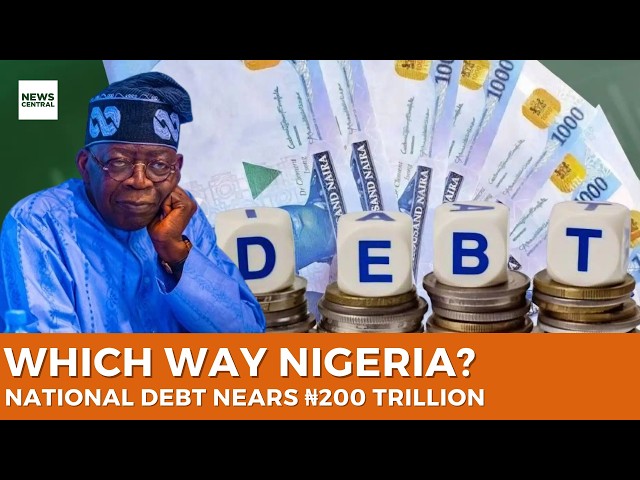
Nigeria’s external debt stock stood at approximately $43.1 billion when Tinubu assumed office in May 2023. By June 2026, it had reached $54.5 billion—an increase of roughly $11.4 billion. Total public debt, including domestic, rose from about N79.39 trillion to N166.79 trillion over the same period, a 90.9 percent increase.
The composition of this borrowing is instructive. Nigeria’s debt to the World Bank rose from $15.4 billion to $20.7 billion. Major World Bank approvals under Tinubu include:
– $2.25 billion for economic reforms (June 2024)
– $1.57 billion for the HOPE and SPIN programmes (September 2024)
– $1.08 billion for education and resilience (March 2025)
Beyond the World Bank, Nigeria returned to international capital markets with a $2.2 billion Eurobond in December 2024 and another $2.35 billion Eurobond in November 2025. A $1.8 billion syndicated loan from First Abu Dhabi Bank was secured, and a $5 billion derivatives financing arrangement was agreed in 2026, of which $1.5 billion had been drawn by June. The Searchlight had x-rayed the opacity of the Abu Dhabi load in the recent past.
And the borrowing continues. In October 2026, Tinubu sought legislative approval for $21.67 billion in fresh external loans, comprising $20.52 billion and €1.045 billion, under the 2026-2027 borrowing plan. The letter read to the Senate by Godswill Akpabio did not provide details of the individual projects the funds would finance.
The Disbursement Gap: Approved Versus Actually Spent
The critical distinction in Nigeria’s loan story is between approval and disbursement. A World Bank loan being “approved” does not mean the money has left Washington. It means the bank has agreed to lend, subject to conditions, procurement rules, and project implementation. The money flows only as projects meet benchmarks.
The disbursement data is damning.
The Adolescent Girls Initiative for Learning and Empowerment (AGILE), the “girls” loan the user references, was approved in September 2023 at $700 million. As of the latest World Bank data, only $148.35 million had been disbursed, leaving $558.22 million available. The project was originally designed in 2020, before Tinubu took office, and runs until 2028. Its reported indicator progress shows 51 percent of indicators achieving less than 40 percent of their targets.
The Nigeria for Women Programme Scale-Up Project, the “women empowerment” loan, was approved in June 2023 at $500 million. Only $109.62 million had been disbursed, leaving $393.67 million available. A project audit from Akwa Ibom State, one of the implementing states, shows IDA credit sources of N8.75 billion cumulatively through October 2024, with cash balances at the state coordinating unit of only N65.9 million by year-end, suggesting funds moved through the system but little remained for active programming.
The pattern repeats across the portfolio. The RENEWED HOPE Governance project had disbursed $3 million out of $500 million. The Primary Healthcare Provision Strengthening Programme had disbursed $75.35 million out of $500 million. The Sustainable Power and Irrigation Project had drawn $33 million out of $500 million. Combined, these three projects had received 7.4 percent of their approved financing.
The March 2025 package, $500 million for HOPE for Quality Basic Education, $500 million for Community Action for Resilience, and $80 million for nutrition, had recorded zero disbursement as of the latest update. The December 2025 financial inclusion project of $500 million and the October 2025 digital infrastructure project of $500 million had also recorded no disbursement.
The government will point out that disbursement takes time, that World Bank projects have multi-year timelines, and that approval is not the same as spending. All true. But the question The Searchlight must press is not why disbursement is slow. It is why approval has been so fast, averaging $3.7 billion per year under Tinubu, compared to $1.82 billion under Buhari, while implementation lags so far behind .
The Missing Explanations: Women, Girls, and the First Lady
On the women’s loan: $500 million was approved. $109.62 million was disbursed. But what did that $109.62 million actually buy? The World Bank’s project documents describe Women Affinity Groups, livelihood support, and institutional strengthening. But there has been no public, itemized accounting from the Nigerian government of what was spent, in which states, with what outcomes. The Akwa Ibom audit shows money moving through state coordinating units, but it is one state out of six geopolitical zones. The other five states’ audits are not in the public domain in any consolidated form.
On the girls’ loan: $700 million approved, $148.35 million disbursed, project runs to 2028. The AGILE project predates Tinubu; it was designed in 2020 under Buhari, so Tinubu cannot be blamed for its conception. But he can be asked why, three years into his administration, disbursement remains at 21 percent and indicator progress is rated “less than 40 percent” for over half the targets.
On the First Lady’s office: The office of the First Lady. Senator Oluremi Tinubu is not a constitutional creation, it has no budget line in the Appropriation Act, and is funded through the Presidency’s administrative structures. Yet, the government has failed to provide a transparent, project-by-project accounting of where loan disbursements went, and in that absence, speculation flourishes.
The absence of an answer is not proof of diversion. It is proof of a transparency deficit that makes diversion impossible to rule out.
The Debt Burden: Who Pays, and for How Long
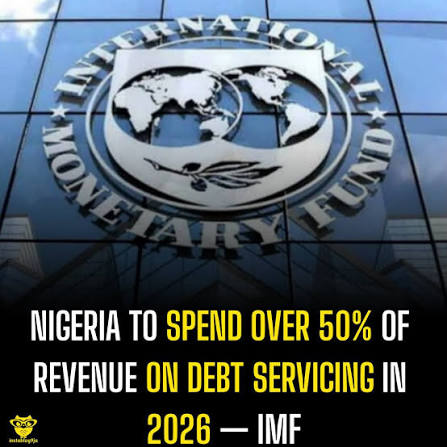
The IMF’s assessment is stark. Interest payments will consume 53.7 percent of government revenue in 2026, up from 40.8 percent in 2024 . The debt-service-to-revenue ratio is projected to remain above 50 percent through 2027.
Per capita, Nigeria’s N166.79 trillion debt means each citizen owes approximately N716,822, an 87 percent increase from N383,442 three years ago.
The maturity profile of the Eurobonds tells the intergenerational story. The December 2024 Eurobond includes $1.5 billion due in 2034. The November 2025 issuance includes $1.10 billion due in 2046. A Nigerian born in 2026 will be 20 years old when the 2046 bond matures. The children of today’s university graduates will still be servicing debt incurred for projects that, on current disbursement trends, may never be completed.
The IMF has warned that Nigeria’s derivatives-based financing arrangement with First Abu Dhabi Bank, the $5 billion facility from which $1.5 billion has already been drawn, is “often complex and lack transparency”. Fitch has flagged liquidity and creditor-recovery risks. These are not opposition talking points. They are assessments from the institutions that lend to Nigeria.
The Accountability Void
Tinubu has never given a comprehensive public accounting of Nigeria’s foreign borrowing under his administration. He has not explained:
– Why $500 million was approved for women’s empowerment and only $109 million disbursed, and where did that $109 million go?
– Why $700 million was approved for girls’ education and implementation is rated below target on most indicators?
– Why the 2026-2027 borrowing plan seeks $21.67 billion without project-level details?
– Why the government is borrowing in dollars and euros when debt servicing already consumes over half of revenue?
The President’s defenders will note that the 2026 budget projects N33.39 trillion in revenue, and that the debt-service ratio in the budget is 48 percent, lower than the IMF’s 53.7 percent projection. But that projection assumes revenue targets will be met. In Q1 2026, the government recorded a N2.24 trillion tax revenue shortfall, N7.44 trillion generated against a target of N9.68 trillion. If actual revenue lands between N20-25 trillion instead of N33.39 trillion, the debt-service ratio could climb back into the 90-120 percent range. At that point, the government would be borrowing to service existing debt, a classic debt trap.
Conclusion: Borrowed Money, Vanished Projects, Unanswered Questions
The Searchlight does not allege that Tinubu’s foreign loans were stolen. It does not claim to have proof that money was diverted to the First Lady’s office or to any other unappropriated purpose.
What it alleges, with documentation, is this: Nigeria has borrowed over $11 billion in external debt under Tinubu, the World Bank has approved over $11 billion in financing, the flagship social projects are disbursing at a fraction of their approved amounts, the government is seeking another $21.67 billion without project details, and the President has never given a full public accounting of any of it.
The women’s loan: $500 million was approved and $109 million disbursed with no public itemization of outcomes.
The girls’ loan: $700 million was approved, $148 million was disbursed, and most indicators show it is below target.
The debt is $54.5 billion external totalling N166.79 trillion, showing N716,822 indebtedness per citizen.
The next request: $21.67 billion, no project list.
This is not a story about whether borrowing is inherently good or bad. It is a story about whether a government that borrows in the name of the people, and in the name of their children, owes those people an explanation. Tinubu’s answer, so far, has been silence.


Leave a Reply