By Matthews Otalike, The Searchlight Correspondent / October 26, 2026
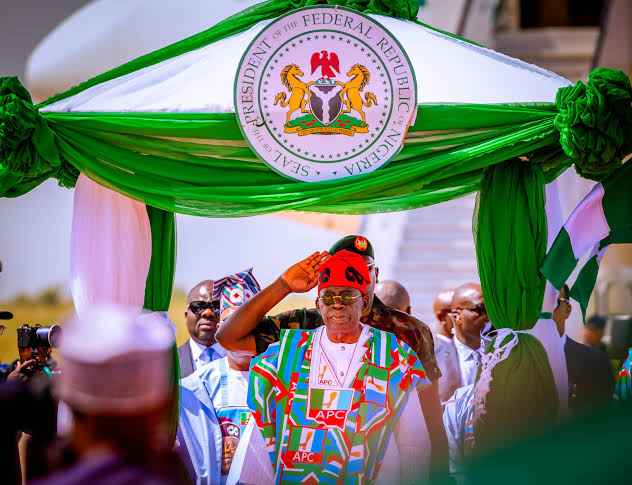
On 24 October 2026, President Bola Tinubu stood at the Kaduna Township Stadium to flag off the APC’s North-West campaign. What he said there was not a campaign speech. It was a confession disguised as an attack.
“I hear my opponent talking about hunger, poverty. Who created it? They did. They created hunger. They created poverty. We are trying to eradicate it,” Tinubu told the crowd.
The opposition, in Tinubu’s telling, created hunger. Not the removal of the petrol subsidy his administration implemented in 2023. Not the Naira’s collapse from roughly ₦471 to ₦1,329 to the dollar. Not the World Bank’s projection that 63 percent of Nigerians will fall below the national poverty line in 2026.
Atiku Abubakar’s response was precise: “The APC has governed Nigeria for over eleven years, including eight years before you took office and three and a half years under your administration. Nigerians know who has been in power”.
But the content of the speech matters less than its context. The rally was held at a stadium. Tinubu reportedly commissioned an unfinished Abuja-Kaduna expressway from inside that stadium, a ribbon-cutting for a road that does not yet exist, and Atiku threw a jab; “A road cannot be completed with a speech or ribbon-cutting ceremony”.
This is the first symptom of the disconnect: the President no longer speaks about the country as it is. He speaks about it as his campaign needs it to be. Hunger is the opposition’s fault. The road is finished because he says it is. The crowd is massive because the party says so, though the ADC alleged attendees were paid ₦50,000 to ₦100,000 each and the stadium remained “sparsely occupied” .
The 12-State Campaign: Preference, Health, or Contempt?
The APC’s “Nationwide Campaign Rally Schedule 2026-2027” lists rallies in all 36 states and the FCT. But only 12 are tagged “President Visibility”, the states where Tinubu will personally appear.
The 12 are: Kaduna, Port Harcourt, Jos, Ibadan, Maiduguri, Enugu, Bauchi, Sokoto, Asaba, Kano, Yola, and Lagos. They are spread across all six geopolitical zones, so the schedule’s defenders can claim geographic balance. But 12 out of 37 is not balance. It is selection.
Why these 12? Three possible explanations, none of them flattering.
The health explanation. Speculation about Tinubu’s health has followed him since before the 2023 election. In September 2026, Omoyele Sowore alleged on Arise Television that Tinubu was hospitalized in France after his three-week trip abroad, and that public appearances were staged to conceal a serious condition . The presidency has not confirmed this. But the pattern, limited public engagements, heavy reliance on intermediaries, extended absences, is consistent with a candidate whose stamina is a managed variable.
The strategic explanation. These 12 states may be where internal polling shows Tinubu is competitive or where the party needs to shore up its base. If so, the other 24 states are being conceded or delegated to surrogates. That is not unusual in presidential campaigns. But in a country where the President is asking for a second term after three and a half years of economic pain, the decision to personally court only a third of the federation is an admission that the other two-thirds are not worth the effort, or not winnable.
The contempt explanation. Tinubu does not need to campaign everywhere because he does not believe he needs to persuade voters. He needs to mobilize the machinery. The 12-state schedule may reflect not where he can win votes, but where the state apparatus, governors, party structures, security agencies, is most reliably under control.
Whichever explanation is true, the political fact is the same: the President is running a campaign designed to minimize his exposure to voters.
Chatham House Revisited: The Man Who Will Not Answer
The 12-state campaign is not the first time Tinubu has managed his exposure by delegating it. At Chatham House in December 2022, then-candidate Tinubu took the stage, delivered a speech, and then did something no presidential candidate at that venue had done. When questions came, he assigned them to surrogates. “I will choose the first question and assign to Dele Alake and the second question assign to Nasir el-Rufai and the third question assign to Ben Ayade,” he said.
His campaign called it “teamship.” Critics called it what it was: an abdication. As Vanguard’s Ikechukwu Amaechi wrote at the time, “No one goes for a job interview and assigns questions posed to him to ascertain his suitability to surrogates”.
The Chatham House episode established a template that has never been abandoned. Tinubu does not do extended interviews. He does not take unscripted questions. He appears at rallies, reads speeches, waves, and leaves. When he does engage with the press, it is through intermediaries, spokesmen, ministers, aides, who absorb the scrutiny he will not.
This is not merely a stylistic preference. It is a governance model. A President who does not answer questions cannot be held to account for his answers. A President who delegates scrutiny to subordinates ensures that the inevitable contradictions and failures belong to them, not to him.
The Missing Register: A Democracy Without a List
If the campaign schedule is a symptom, the voter register is the disease.
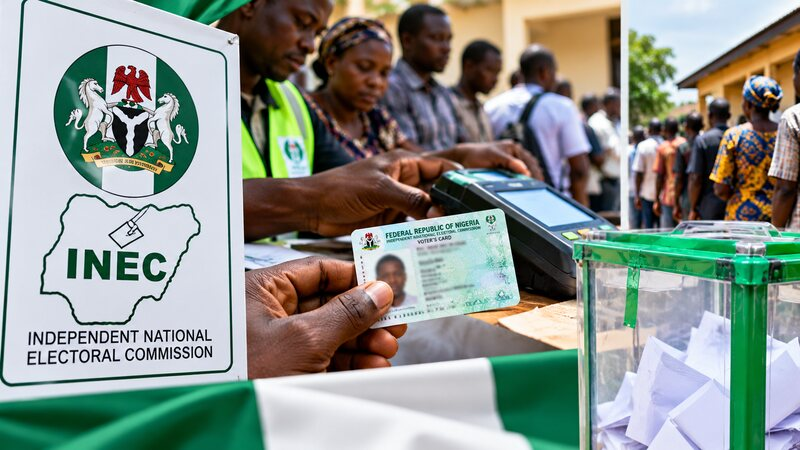
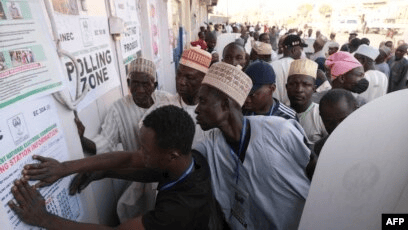
Nigeria’s Electoral Act requires INEC to display the voters’ register for public scrutiny at least 90 days before a general election. With the presidential election set for 16 January 2027, that deadline fell on 18 October 2026. Section 19(2) provides 14 days from the date of display for claims and objections.
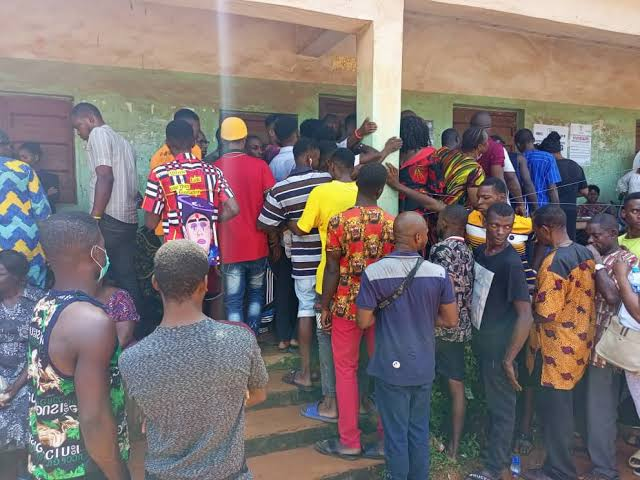
INEC announced a display period from 9 to 15 October. Nigerians went to the portal. According to Atiku Abubakar, they found an empty page. “INEC has announced more than 103 million registered voters. Nigerians went to its portal to inspect the names and found an empty page. That is an outrage,” he said.
A former INEC National Commissioner, Festus Okoye, offered a clarification that raised more questions than it answered. He said the October display was not the final register required under Section 19(1) but a supplementary register from the Continuous Voter Registration exercise. The main register, he said, was not ready because claims and objections must be concluded before the supplementary register is integrated.
This is a remarkable admission. If the main register is not ready, and the statutory 90-day deadline has passed, then the claims and objections process, the only mechanism by which a voter can verify that their name is on the list and challenge unlawful additions or removals, cannot function as the law intends. A 14-day window that opens without a register to inspect is not a window at all. It is a formality performed in the dark.
A civil society group, CCND, threatened to seek an order of mandamus compelling INEC to publish the register and extend the claims period if it failed to comply by 30 October. Atiku called on international partners and observers to press INEC publicly.
The question The Searchlight must ask is the one INEC has not answered: Why is the register not ready?
There are innocent explanations. Nigeria’s voter registration process is chaotic, underfunded, and technologically fragile. Integrating new registrants takes time. Errors happen.
But there is also an explanation that the government’s critics have offered, and that the facts do not yet refute: a delayed register makes verification impossible, and an unverifiable register makes manipulation easier. If voters cannot check their names, they cannot object when those names disappear. If the register is published too late for meaningful scrutiny, the claims and objections process becomes a theatrical gesture rather than a safeguard.
Atiku also raised a separate concern about Section 63(2) of the Electoral Act, which allows a returning officer to count ballot papers without INEC’s official mark if satisfied they came from a book supplied to the polling unit. “What evidence will establish that origin? Who will verify it, and how will parties challenge a false claim?” he asked.
Put the two concerns together. A register that cannot be verified. Ballot papers that may be counted without the official mark. The architecture of a credible election requires both a trustworthy list of who may vote and a trustworthy ballot that records how they voted. If both are compromised before the first vote is cast, the election is not a contest. It is a ratification.
What Type of Disconnect Is This?
The Kaduna speech, the 12-state schedule, the Chatham House precedent, and the missing register are not separate problems. They are four expressions of a single governing logic: Tinubu’s relationship to accountability has been severed, and the machinery of his presidency is organized around managing the consequences of that severance.
He does not answer questions because answering questions creates accountability. He campaigns in 12 states because campaigning everywhere creates exposure. He blames the opposition for hunger because acknowledging his own role creates political vulnerability. He governs through intermediaries because intermediaries can be blamed.
And when the electoral infrastructure itself becomes a question, when the register that determines who may vote is invisible two months before the vote, the same logic applies. A President who does not account to the people does not need the people to be able to verify their own participation.
This is not a health story, though health may be part of it. It is not a scheduling story, though strategy may explain some of it. It is a story about a President who has constructed a presidency that insulates him from the one thing democracy requires: the obligation to face the people and answer for what he has done.
CLOSING
The Kaduna rally was held in a stadium. The road the President commissioned does not exist. The crowd was rented or real, depending on whom you believe. The register Nigerians were told to inspect, they say they could not find. And the President will spend the next two months appearing in 12 states, answering no questions, blaming his opponents for the hunger in the streets.
If this is a campaign, it is a campaign for a second term without a first-term accounting. If this is a democracy, it is a democracy in which the incumbent has decided that the voters are not the audience. They are the obstacle.


Leave a Reply