By The Searchlight Investigative Desk
In Parts I and II, The Searchlight traced the hounding of Dr. Obadiah Mailafia and the architecture of silence that buried his warnings. This final installment confronts the question at the heart of his allegations: Who arms the gunmen? And why, when evidence of official complicity surfaces, does the machinery of investigation so rarely turn toward the powerful?
The answer that emerges from the public record is not a single conspiracy, but a political economy of impunity, a system in which arms flow through official and semi-official channels, community leaders are absorbed into security arrangements and then accused of betrayal, and the questions that matter most are the ones never asked.
The Kwara Arms Scandal: A Case Study in Contradiction
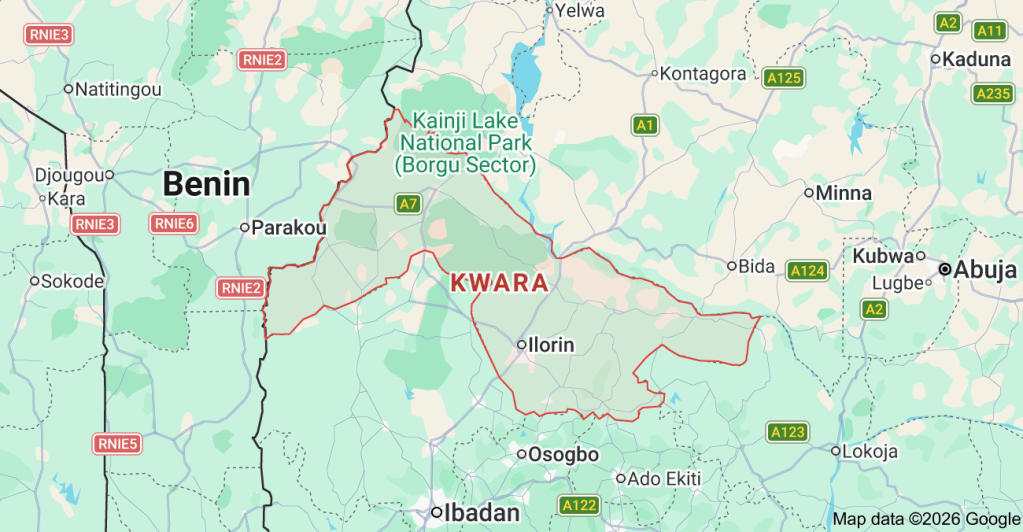
In December 2025, soldiers intercepted armed men in Ifelodun Local Government Area of Kwara State. The men were carrying AK-47 rifles and operating in a patrol vehicle allegedly linked to the Kwara State Government. What followed was not a transparent investigation, but a cascade of official contradictions that exposed the fault lines Mailafia had warned about.
The Kwara State Government initially denied involvement. Then it confirmed that the arrested men were members of Miyetti Allah operating under a federal security arrangement coordinated by the Office of the National Security Adviser (ONSA). Then the NSA’s office acknowledged that arms had been issued to “vigilantes” under so-called “hybrid security operations,” citing the Terrorism Prevention and Prohibition Act. Then the NSA’s office performed what former APC Deputy National Publicity Secretary Timi Frank called a “sudden and suspicious U-turn,” denying that it had armed “kidnappers, militias, or socio-cultural groups” and insisting the individuals were merely “vigilantes known to the NSA”.
Frank’s questions are the ones the state has not answered: “Who authorized the arms? Who recruited these armed men? Why did official accounts change repeatedly within days? Is the Kwara State Governor telling the truth, or is the NSA covering up?” He described the contradictions as evidence of “either gross incompetence or a deliberate cover-up”.
The contradictions matter because they are not abstract. The men arrested in Ifelodun were not ghosts. They were armed, mobile, and linked—by vehicle and by official admission—to a security architecture coordinated at the highest levels of the Nigerian state. Whether they were “vigilantes” or “bandits” is precisely the question that a serious investigation would resolve. No such investigation has been publicly documented.
The Miyetti Allah Arrests: Community Leaders, Criminal Networks, and the ONSA Arrangement
The Kwara arms scandal did not occur in a vacuum. In January 2026, three senior leaders of the Miyetti Allah Cattle Breeders Association of Nigeria (MACBAN) in Kwara State, including its president, Idris Abubakar, were arrested over alleged involvement in sponsoring banditry and kidnapping operations across the state.
Security sources told Tell magazine that the arrests followed intensified military pressure on criminal enclaves in Ifelodun, Edu, and Patigi LGAs, and that the suspects, described as elderly Fulani men, were alleged to have provided logistical support, facilitated abductions, and channelled funds to armed groups operating along the Kwara–Niger axis.
The timing is not incidental. The arrests came after the ONSA had reportedly engaged some Miyetti Allah members in a Joint Task Force–style arrangement with local vigilantes in late 2025, to counter escalating attacks in Ifelodun. Allegations later surfaced that some participants absconded with issued weapons, raising concerns about oversight.
This is the architecture Mailafia described in 2020, in miniature. A state security arrangement absorbs a community group. Weapons are issued. Some of those weapons disappear into criminal networks. When the consequences surface, the official response is not to trace the weapons, audit the arrangement, or hold the architects accountable. It is to arrest the community leaders, deny the scale of the problem, and move on. The question of who designed the arrangement, who approved the weapons transfers, and who monitored the recipients is left unasked.
The Arms Market in the Open
If the Kwara case shows the political dimension of arms proliferation, a viral video from February 2026 shows its operational dimension. The footage, circulated on social media, showed armed men inside a room displaying large quantities of weapons and ammunition, AK-47 rifles and anti-aircraft guns, and calmly advertising them to herdsmen and bandits from surrounding forests, as though they were ordinary merchandise.
A security source told SaharaReporters: “Imagine, those are a group of bandits that are in the town inviting Fulani herdsmen or bandits that are inside the bush to come and buy weapons from them. They are even advertising to their fellow bandits”.
The source’s conclusion was blunt: “Those people must have sponsors that are backing their matter up. It is God alone that can save our country”. He added that “bandits are using AA and AK while our men are using riot guns. Government cannot even give us enough equipment or weapons to protect our people”.
This is not a marginal phenomenon. It is an organized arms market operating inside a Nigerian town, supplying sophisticated weaponry to forest-based armed groups. The existence of such a market implies supply chains, financiers, and protectors. It implies, in short, sponsors. The state’s failure to dismantle it, or even to publicly acknowledge its scale, is not a failure of capacity alone. It is a failure of will.
The Confessions and the Silence
In April 2026, another video surfaced. Captured bandits, shirtless and restrained, confessed under interrogation that government officials supplied them with vehicles and sophisticated weapons used to terrorize communities. One suspect, speaking in Pidgin English, directly fingered Kwara State government officials: “Ilorin government na him give us this motor and the weapons. I swear!”.
The video triggered outrage, but no official investigation into the specific allegations has been publicly documented. No officials have been named, charged, or cleared. The confessions remain, in the public record, as viral footage, evidence of a problem that the state has neither confirmed nor dispelled.
This is the pattern that Mailafia identified and that the state has never confronted: allegations of official complicity surface, circulate, and then disappear into the void of non-investigation. The absence of investigation is not neutral. It is a choice. And it is a choice that protects the powerful while leaving the powerless to bear the consequences.
The Kaduna Denial: Cover-Up as Reflex
The same pattern operates at the level of mass atrocities. In January 2026, gunmen attacked three churches in Kajuru LGA, Kaduna State, and abducted over 100 worshippers. The Kaduna police command dismissed the reports as “falsehood spread by conflict entrepreneurs,” challenging those spreading the reports to provide names and details of the victims.
Only after the Christian Solidarity Worldwide–Nigeria (CSW-N) confirmed the abductions and accused security operatives of obstructing independent verification did the police reverse course, confirming the incident and deploying assets to rescue the victims.
The PDP’s response captured the significance of the reversal: the initial denial was a “dangerous pattern recurrent in the course of this administration’s normalization of insecurity and a deliberate attempt to obscure the truth from Nigerians.” The party added: “These denials are deeply hurtful, not only because they are evidently false, but because they reveal the manifest levity with which this administration treats serious matters like security”.
The Kaduna denial was not an isolated error. It was a reflex, the same reflex that led to Mailafia’s hounding, the same reflex that produced the military’s suppression directive, the same reflex that allows arms scandals to dissolve into official silence. The reflex is to control the narrative before controlling the security situation. And the consequence is that the truth about who is arming whom, and why, remains buried.
What Is the APC Administration Hiding?
The question, posed in Part I, can now be answered with greater precision. The APC administration is not hiding a single, monolithic secret. It is hiding a system—a system in which:
· Arms flow through official and semi-official channels (the ONSA “hybrid” arrangements) with insufficient oversight, and disappear into criminal networks;
· Community leaders are absorbed into security arrangements and then, when the arrangements fail, are arrested as sponsors, while the architects of the arrangements remain untouched;
· Allegations of official complicity—from captured bandits, from whistleblowers, from state officials themselves—are met with denial, contradiction, and non-investigation;
· Atrocities are denied until independent verification makes denial untenable, and then acknowledged with minimal transparency;
· Information about ongoing attacks is suppressed—by direct military directive, according to credible sources—to protect the political image of the ruling party ahead of the 2027 elections;
· The media is disciplined into complicity through fines, “national interest” doctrines, and the threat of being labelled unpatriotic.
This is not a failure of governance in the ordinary sense. It is a governance of concealment—a system in which the priority is not the protection of citizens but the protection of the narrative. Mailafia saw it in 2020. The Kwara arms scandal, the Miyetti Allah arrests, the bandit arms market, the Kajuru denial, and the suppression directive are all evidence that the system he identified has not only persisted but deepened.
The Unfinished Investigation
Obadiah Mailafia is dead. The governor he accused has never been publicly investigated. The commanders he cited have never been publicly identified or questioned. The logistics network he described has never been the subject of a transparent official inquiry. The sponsors he warned about have never been named by the state—only by captured bandits, in videos that circulate and then fade.
The Searchlight does not claim to know the full truth of what Mailafia alleged. What it claims is that the truth has never been sought. The state investigated the messenger. It fined the platform. It summoned the whistle-blower. It threatened the leakers. It denied the abductions. It suppressed the attacks. And it left the sponsors in the shadows.
That is the indictment. Not that every allegation is proven, but that none of them were ever seriously investigated. And in that absence of investigation, the gunmen continue to arm, the bandits continue to buy, the officials continue to contradict themselves, and the Nigerian people continue to pay the price.
The Searchlight will not be silent. Neither should you.


Leave a Reply