By Matthews Otalike, The Searchlight Editorial Board / October 22, 2026
There is a difference between a suspicion and a scandal. What is unfolding at the Independent National Electoral Commission is not yet the latter. But it is rapidly becoming the former, and in the business of electoral administration, a suspicion left unanswered long enough hardens into a certainty.
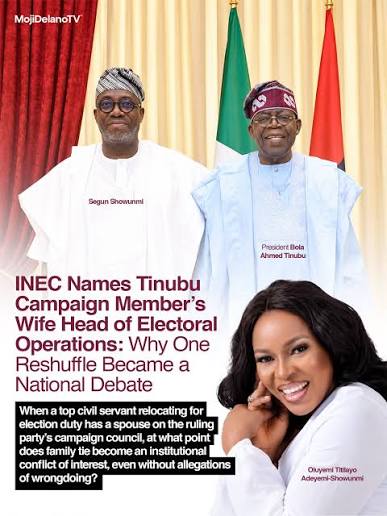
The facts, as they stand, are these. Oluyemi Titilayo Adeyemi-Showunmi, until recently INEC’s Administrative Secretary in Lagos, has been redeployed to head the commission’s Electoral Operations Department at its Abuja headquarters. That department is not a backwater. It coordinates the nationwide distribution of election materials, the recruitment and training of the ad hoc staff who will actually run polling units, the deployment of personnel, and the supervision of collation and returning officers. It is, in plain terms, the operational engine room of any Nigerian election.
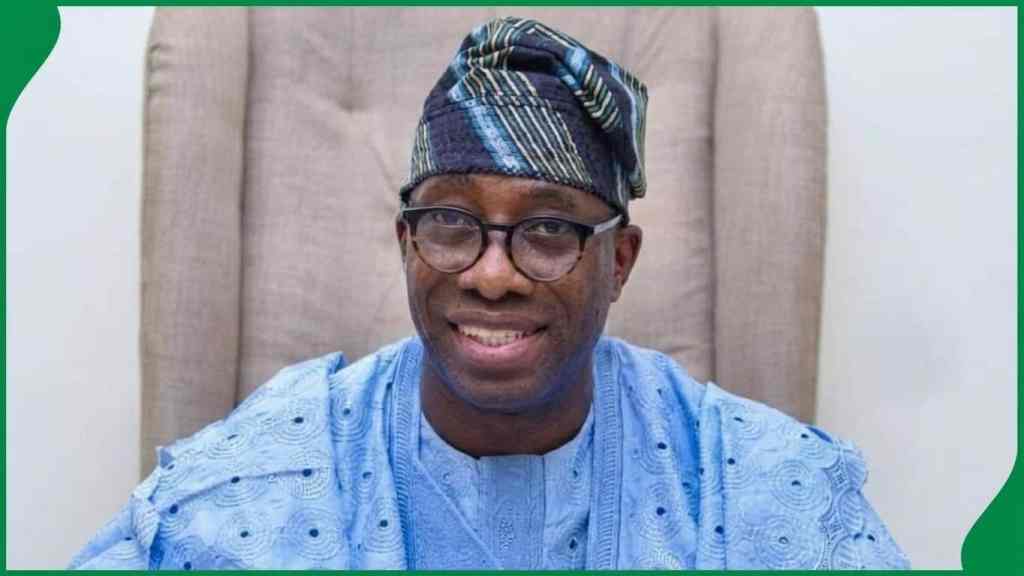
Her husband is Segun Sowunmi, a member of the All Progressives Congress’ 2027 Presidential Campaign Council and a man who has publicly campaigned for President Bola Tinubu’s re-election. When confronted with the obvious question, whether his wife’s new position was a reward for his political service, Sowunmi’s response was indignation. “Reward who?” he demanded on Channels Television, before offering the defence that has since become the standard line of the commission’s apologists: his wife is a Level 17 career civil servant who has spent her entire working life at INEC, and anyway, “didn’t Peter Obi win [Lagos] in 2023?”
That defence is clever. It is also irrelevant.

The argument that Adeyemi-Sowunmi’s tenure as Lagos Administrative Secretary coincided with Peter Obi’s victory in the state proves nothing about her neutrality in her new role. An administrative secretary does not control the distribution of sensitive materials or the deployment of polling-unit staff. An operations director does. As one incisive commentary put it, the appeal to 2023 relies on “a false equivalence”, the structural authority of the two positions is simply not comparable, “even in a minor organization,” let alone within INEC. That Peter Obi won Lagos while she was administrative secretary tells us that she did not single-handedly rig Lagos for the APC. It tells us nothing about what she might do, or be positioned to do, with operational command of the entire country’s election logistics.
This is the crux of the matter, and it is a point that The Searchlight wishes to press with some force: the issue is not whether Adeyemi-Showunmi is personally corrupt. The issue is that INEC has placed a person with a direct, publicly acknowledged family tie to the ruling party’s campaign apparatus in charge of the department that decides where ballot papers go, who hands them out, and who supervises the count. In any institution that took public confidence seriously, the burden would be on the commission to explain why this was unavoidable. INEC has offered no such explanation. It has offered silence.
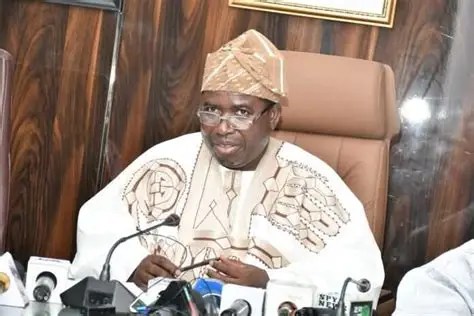
And it is not an isolated case. In the same period, President Tinubu nominated Professor Mustapha Aliu as INEC National Commissioner for the North-West. Professor Aliu is the maternal brother of Sokoto State Governor Ahmed Aliyu, who is himself seeking re-election under the APC. The North-West commissioner will oversee elections in seven states, including Sokoto. The constitutional requirement that an INEC member not belong to a political party is a thin shield when the nominee’s brother is the ruling party’s gubernatorial candidate in a state he will help administer. HURIWA has demanded that INEC Chairman Joash Amupitan explain the criteria behind these redeployments and disclose the safeguards in place to prevent political considerations from influencing sensitive appointments. Atiku Abubakar has made similar demands, calling for full transparency in the appointment process and in the contracting of sensitive election materials. The commission’s response has been, at best, perfunctory.

The Searchlight does not assert that the 2027 election has already been rigged. That claim would require evidence we do not possess, and it would do a disservice to the gravity of the situation to pretend otherwise. But we do assert this: the conditions under which an election can be rigged are being assembled in plain sight, and the institution responsible for preventing that outcome is doing nothing to dispel the impression that it is a willing participant.
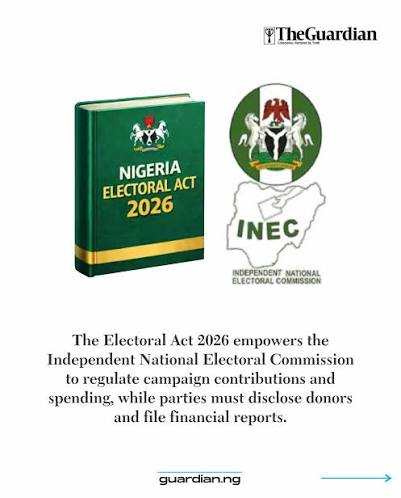
Consider the broader architecture. In February 2026, President Tinubu signed the Electoral Act Amendment Bill into law with a clause making electronic transmission of results *optional* rather than mandatory. The House of Representatives had initially passed a version mandating transmission to the IReV portal; the Senate stripped it out, and the president commended lawmakers for “preventing potential hacking”. The caveat that Form EC8A, a paper document, would serve as the primary collation basis in the event of network failure means that the most vulnerable link in the chain, the physical result sheet at the polling unit, remains the ultimate arbiter. In an environment where the personnel handling those sheets can be compromised, the retreat from mandatory electronic transmission is not a technical adjustment. It is an invitation.
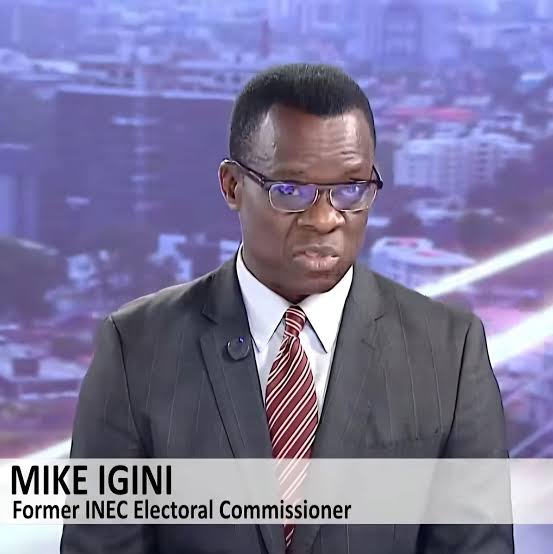
And the personnel can be compromised. Former INEC Resident Electoral Commissioner Mike Igini said last week what many have long suspected: politicians infiltrate the NYSC lists from which ad hoc polling staff are drawn, insert unauthorized names, sew NYSC uniforms for them, and deploy them to polling units. Igini described encountering exactly this in Akwa Ibom in 2019, when a market woman’s name appeared on a training list for election duty. His warning is precise and damning: “The laws are no longer enforced. That is my greatest worry about this election”.
Put these pieces together. A ruling-party campaign official’s wife controls the department that recruits and deploys the ad hoc staff. The recruitment pipeline for those staff has been publicly identified as vulnerable to infiltration. The legal requirement that results be transmitted electronically has been weakened. The man who will oversee the North-West, including his brother’s state, sits on the commission. And the commission’s chairman has declined to offer a substantive public accounting for any of it.
This is not a conspiracy theory. It is a description of a system in which every safeguard that might catch a manipulation has been either weakened, left ambiguous, or staffed by someone with an interest in looking the other way. The Searchlight is not in the business of predicting electoral theft. But we are in the business of naming the conditions that make theft possible, and of asking why those conditions are being allowed to persist when the remedies are obvious and available.
INEC Chairman Amupitan has a choice. He can publish the criteria for these redeployments. He can institute a clear recusal policy for officials with direct family ties to candidates or campaign councils. He can demand that the NYSC certify its lists and that INEC independently verify every ad hoc staff member before deployment. He can make the case, publicly and with evidence, that the operational chain is insulated from political pressure. Or he can do what he has done so far: nothing that anyone outside the commission’s walls can verify.
The Searchlight’s position is simple. Nigerians are not obliged to trust an electoral commission that refuses to explain itself. When the referee’s spouse is on the payroll of one of the teams, the referee does not get to say “trust me” and leave it at that. He shows his cards, or he forfeits the game. The 2027 election is not yet lost. But the credibility of the institution that will run it is being lost, day by day, in the silence that follows every unanswered question.
The Searchlight will continue to follow this story.


Leave a Reply