By Matthews Otalike, The Searchlight Desk / September 14, 2026
The September 14th Feast of the Exaltation of the Holy Cross is, like many feasts on the liturgical calendar, one that has both an historical and a spiritual dimension – though one could certainly argue that the historical has more than a touch of the spiritual in it!
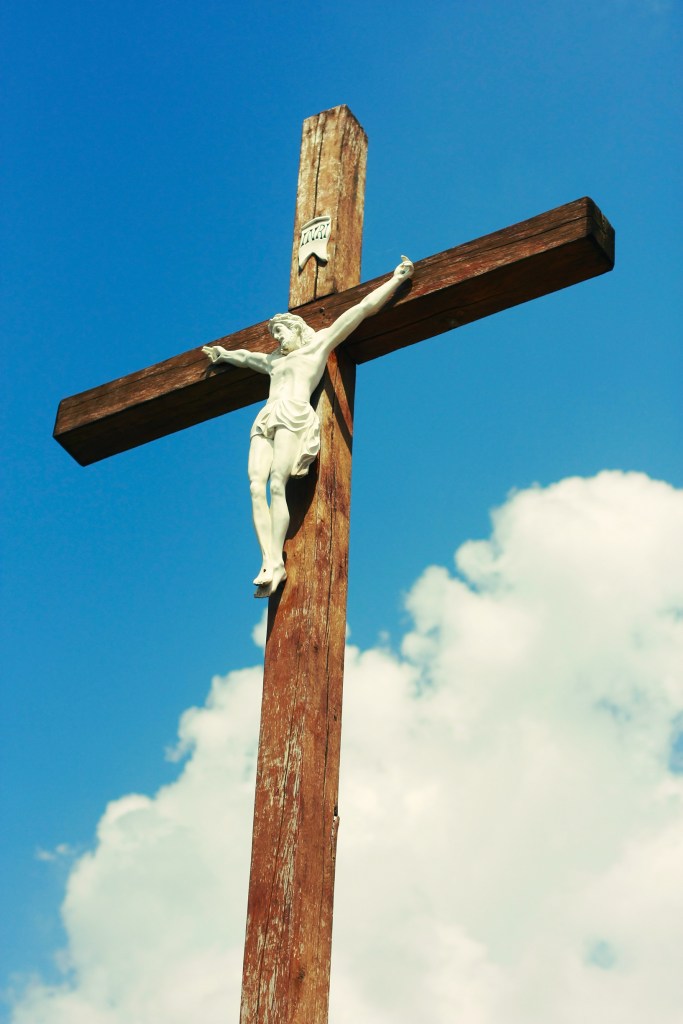
From the standpoint of history, we celebrate two historical events: First, the finding of the True Cross by St. Helena in the fourth century, and second, the recovery of the True Cross from the Persians by the Emperor Heraclius in the seventh century. In the first instance, after consulting with local Christians, St. Helena came to discover the site of crucifixion in the year 326, thanks in part to the sweet smell of basil growing in the area. Upon uncovering three crosses that had been buried in trash beneath a pagan temple, she placed on each of them the body of a dead man whose funeral procession was passing nearby: With the first two crosses, nothing happened, but the third brought the dead man back to life! St. Helena had the temple destroyed and a Christian Church built over the site, which we know today as the Church of the Holy Sepulchre – the site of the crucifixion, burial and resurrection of the Lord. Her son Constantine the Great dedicated the Church on September 13-14, 335. Nearly 300 years later, in the year 614, the Persians sacked Jerusalem and stole the True Cross. Emperor Heraclius of Constantinople got it back in a campaign defeating the Persians. However, he was mysteriously prevented from triumphantly entering the city with it. It wasn’t until he humbled himself and removed his magnificent garments that he was able to ascend Mount Calvary and return to the True Cross to its rightful home on September 14, 629.
From these two historical events we can take away some spiritual lessons, which can be summed up in what Jesus says to his disciples (and to all of us), “If any man would come after me, let him deny himself and take up his cross and follow me. For whoever would save his life will lose it, and whoever loses his life for my sake will find it” (Matthew 16:24-25). The cross, which we are called to carry in imitation of our Lord, is life-giving. The triumph of the Cross is nothing short of our redemption: Because Christ the King took his throne upon the cross, man is once again able to live the life of God, which is a life of love.
But the mystery of this paradox – a life-giving instrument of death – can be hard to accept, and many choose to reject it. It’s a choice that Archbishop Fulton Sheen would frequently lament. He often said that there is nothing more tragic in all the world than wasted pain.
Calvary is a place of great impatience. Many souls follow Our Lord to
the Mount of Beatitudes, but refuse to follow Him to Calvary; some carry
their cross to Calvary, but when they get there, they lay it down; some are
stripped of the garments of doubt but refuse to be nailed in the fullness of
sacrifice; others are nailed but unfasten themselves before the elevation
of the Cross; others are crucified but answer the challenge of the world
and come down after one hour, after two hours, within a minute of the
sound of three. The world is full of half-crucified souls. Few there are who
stay until the very end; few there are who know what it is to give all, to
see the work well done and experience the thrill of a victory won. Would
that there were a single day in our lives in which we could honestly say,
“I have given God all! It is finished.”
— Good Friday Radio Address, 1935
The crowd at the crucifixion promised to believe that he was the Son of God if only he would save himself. They wanted religion without a cross, Sheen asserted in one of his television episodes, “Why didn’t Jesus come down from the Cross?” he asks, “Because if he had come down from the cross, he wouldn’t have saved us. To come down would have been human. To stay was divine.”
We are invited, as St. Peter says, to be partakers in his Divine nature. St. Paul writes in Romans 6 that we who are baptized into Christ are baptized into his death, saying, “if we have been united with him in a death like his, we shall certainly be united with him in a resurrection like his.” On this Feast, liturgically speaking, we should begin to focus on our preparations for the Nativity of Our Lord, with the life-giving cross as our starting point. As Advent is traditionally a time of prayer and fasting, today we can resolve to offer up voluntary penances, as well as our involuntary sufferings, and unite them to the suffering of Christ in the hope of the new life he has promised. We can also do this, Sheen points out, in offering ourselves in the Liturgy:
So, the Christ goes out into the world, gathering up other human natures who are willing to be Christs. In order that our sacrifices, our sorrows, our Golgothas, our crucifixions, may not be isolated, disjointed, and unconnected, the Church collects them, harvests them, unifies them, coalesces them, masses them, and this massing of all our sacrifices of our individual human natures is united with the great Sacrifice of Christ on the Cross in the Mass.
When we assist at the Mass, we are not just individuals of the earth or solitary units but living parts of a great spiritual order in which the Infinite penetrates and enfolds the finite, the Eternal breaks into the temporal, and the Spiritual clothes itself in the garments of materiality. Nothing more solemn exists on the face of God’s earth than the awe-inspiring moment of Consecration; for the Mass is not a prayer, nor a hymn, nor something said—it is a divine act with which we come in contact at a given moment of time.
— Calvary and the Mass


Leave a comment