By The Searchlight Editorial Team / July 20, 2026
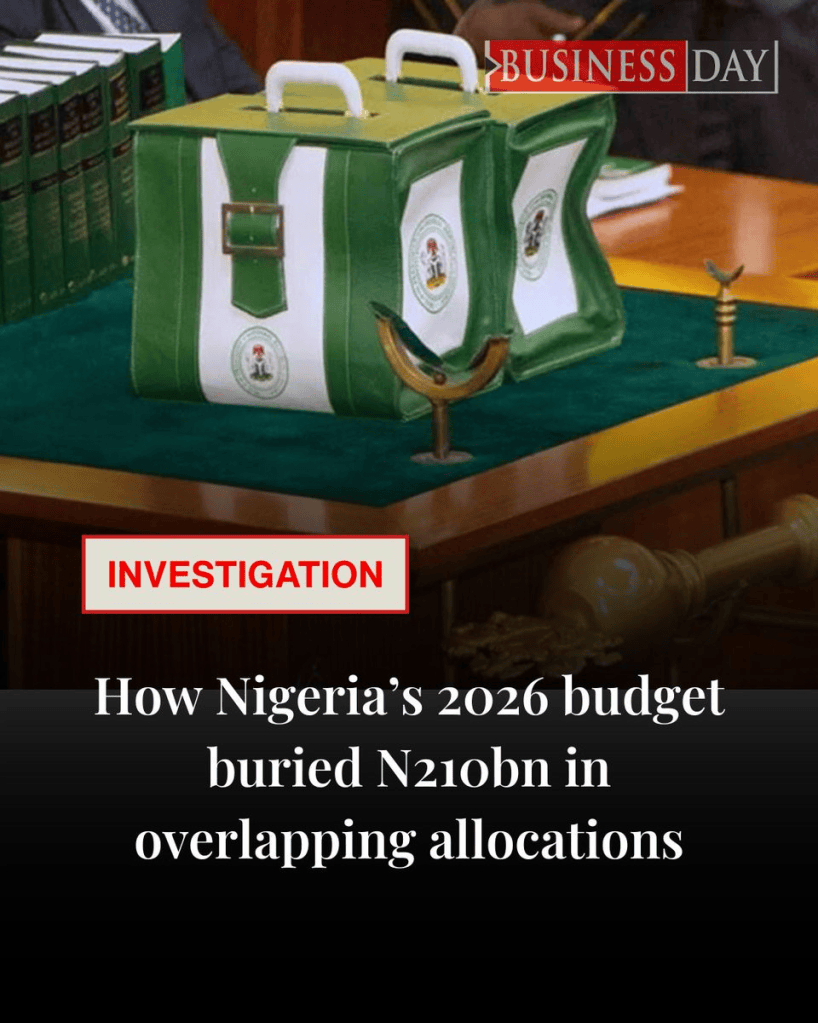
The 2026 Appropriation Act is not merely a fiscal document; it is a damning indictment of Nigeria’s governance crisis. Beneath the headline figures of N68.32 trillion lies a disturbing reality: our Ministries, Departments, and Agencies (MDAs) are being systematically stripped of their statutory mandates and reduced to mere execution vehicles for political patronage. This is institutional cannibalization disguised as grassroots development.
The Institutional Farce
Nothing underscores this absurdity more vividly than the case of the National Commission for Almajiri and Out-of-School Children Education . Created to confront one of Nigeria’s gravest educational crises, the Commission found itself saddled with N8.4 billion for road construction in Ogun, Katsina, and Ekiti states. This represents approximately 91.98 percent of its entire budget diverted to projects bearing absolutely no relation to its statutory functions .
The Commission’s spokesperson, Nura Muhammad, confirmed the chilling reality that “these projects are National Assembly constituency projects incorporated into the 2026 Appropriation Act for implementation through the Commission” . The admission lays bare the fundamental perversion of our budgetary process: lawmakers have transformed themselves from legislators into project managers, with MDAs as their unwitting contractors.
Budgetary Vandalism by the Numbers
The scale of this assault is staggering. Sixteen federal agencies received more than N205.96 billion for projects completely outside their statutory mandates . Consider these examples:
The Institute for Peace and Conflict Resolution, whose core mandate is conflict prevention and peace-building, was allocated N17.78 billion—91.98 percent of its entire budget—for solar streetlights, fertilizer distribution, and classroom construction .
The National Root Crops Research Institute, Umudike, a body devoted to agricultural research and improving root crop production, received N59.12 billion from its N71.03 billion budget for roads, bridges, and health infrastructure—effectively turning a research institute into a construction company .
Even more egregiously, the New Partnership for Africa’s Development (NEPAD) received N12.74 billion for classrooms, hospitals, and roads—nearly 72 percent of its budget allocated to functions bearing zero relevance to its continental development mandate .
The Oil and Gas Free Zones Authority received N32.10 billion for dams, schools, police stations, and constituency generators . How does any of this relate to the regulation of oil and gas free zones?
The Constitutional Schizophrenia
The 1999 Constitution grants the National Assembly powers to make laws and exercise oversight . Nowhere does the Constitution assign legislators the responsibility of executing projects. Section 7 recognizes democratically elected local governments, while the Fourth Schedule explicitly assigns them responsibilities including the construction of roads, streets, street lighting, and primary healthcare facilities .
When federal legislators insert boreholes and classroom renovations into the national budget, they encroach upon responsibilities constitutionally assigned to local governments. This structural overlap undermines the very foundations of federalism and institutional clarity .
The Executive’s Complicity
The Tinubu administration cannot escape responsibility. Despite enjoying veto power and controlling the budget formulation process, the executive has allowed this practice to flourish. Former President Olusegun Obasanjo aptly described this practice as “daylight robbery,” yet successive administrations have tolerated—indeed, enabled—this systematic distortion of national priorities .
President Tinubu directed MDAs to ensure “disciplined, transparent, and efficient utilisation of allocated resources” . Yet how can agencies ensure efficiency when their budgets are hijacked for purposes never contemplated by the laws establishing them?
Defense, Not Defense
Some lawmakers claim they do not control implementation once projects are inserted . This strains credibility. Their own colleagues have admitted that lawmakers choose the agencies, negotiate with officials beforehand, and monitor implementation afterward. Some even acknowledged that the size of a lawmaker’s constituency projects depends largely on his influence within the National Assembly .
Beyond Constituency Projects: The Overlap Scandal
The crisis extends beyond off-mandate insertions. A Business-Day investigation uncovered at least N210.23 billion in overlapping allocations and duplicated functions across MDAs . The Office of the Special Adviser on Policy and Coordination appeared twice under the service-wide vote with separate allocations. The National Poverty Reduction with Growth Strategy received funding through different budget channels. The Federal Road Safety Corps’ mass transit bus programme was fragmented into five separate budget entries, each carrying N1.3 billion .
As Atiku Abubakar rightly demanded, this represents “a budget riddled with duplication, questionable insertions, overlapping projects and expenditures that offend both common sense and fiscal responsibility” .
The Path Forward
The consequences are devastating. Agencies abandon planning. National priorities are replaced by political convenience. Education suffers because education agencies cannot focus on education. Agriculture suffers because agricultural institutions become road contractors .
The government must undertake a comprehensive review of obscure commissions and agencies that have become convenient warehouses for constituency projects. Those that have outlived their usefulness should be scrapped. Anti-corruption agencies must classify arbitrary insertions as acts of corruption and prosecute offenders .
Most fundamentally, the judiciary must be approached to clarify the constitutional limits of legislative powers in budget preparation . The National Assembly must return to its constitutional mandate: lawmaking and oversight, not project execution.
History will not be kind to those who have reduced our appropriation process to a marketplace of personal interests. Nations that once looked up to Nigeria have overtaken it because they plan, prioritize, and allow institutions to perform the functions for which they were created .
The time for reform is now. Our institutions’ survival depends on it.


Leave a comment